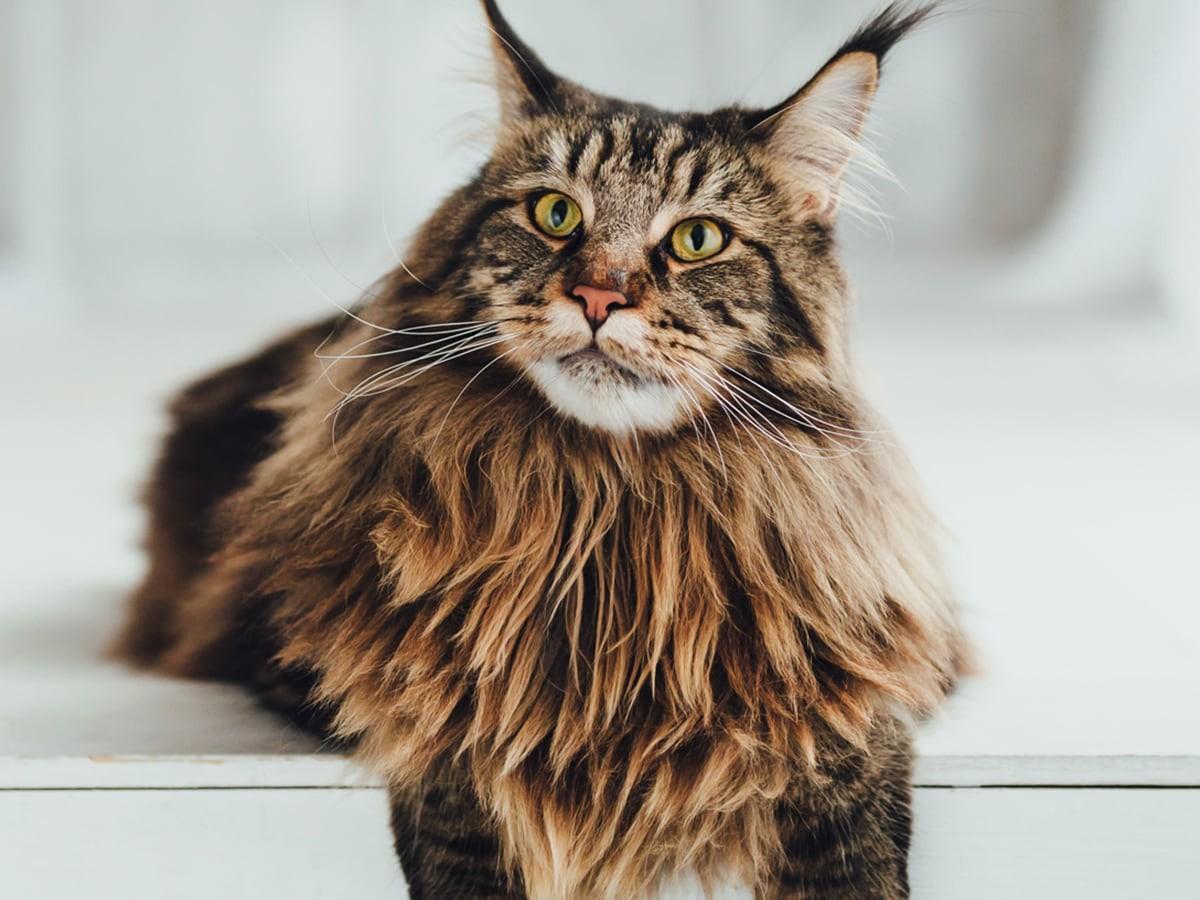
Maine Coon cats come in more than 80 recognized color variations, spanning five main categories: solid, tabby, smoke and shaded, parti-color, and bicolor. The Cat Fanciers' Association (CFA)¹ accepts Maine Coons in nearly every traditional feline color, with three exceptions — chocolate, lavender, and colorpoint (Himalayan) markings, which indicate hybridization outside the breed standard.
Solid-Colored Maine Coons
A solid Maine Coon carries a single uniform color from root to tip, with no stripes, swirls, or ticking. The CFA recognizes five solid colors for the breed: white, black, blue (a soft blue-gray), red (ginger), and cream.
White Maine Coons are visually striking but come with an important genetic note. Research published in PLOS Genetics found that all 31 blue-eyed Maine Coons studied in a specific breeding line carried a PAX3 gene mutation linked to dominant blue eye color and hearing loss.² White Maine Coons with gold or green eyes are not associated with that same genetic marker. If you're considering a blue-eyed white Maine Coon, ask the breeder whether hearing testing has been done.
For context on other pale-coated breeds and their distinct traits, see our guide to white cat breeds.
Tabby Patterns
Tabby is the most common pattern type in Maine Coons and comes in three main varieties:
Classic (blotched): Bold swirling "bullseye" patterns on the sides and back
Mackerel: Narrow vertical stripes running from the spine downward, resembling a fish skeleton
Ticked: No visible body striping — each individual hair is banded with alternating light and dark segments
Each tabby pattern can occur across multiple base colors, including brown, silver, blue, and red. Tabby describes a pattern, not a color. A brown tabby Maine Coon is genetically a black cat with the tabby gene modifying how the coat expresses.
Brown tabby is the most historically common Maine Coon appearance and the pattern most associated with the breed.
Smoke, Shaded, and Silver Coats
Smoke and shaded Maine Coons have pale undercoats beneath darker outer hair tips. When the cat moves or the fur is parted, the lighter base becomes visible — a distinctive quality that makes these coats appear to shift color in motion.
Smoke: The undercoat is pale silver or white, and the outer 80–90% of each hair shaft carries deep color. Common variations include black smoke and blue smoke.
Shaded: Color covers only the outer 25–30% of each hair, producing a sparkling, lighter appearance than smoke.
Chinchilla silver: An extreme version of shaded, with only the very tips of the hairs pigmented, creating a nearly white cat with a subtle dusting of color across the back.
Smoke and shaded patterns are often difficult to identify in kittens and become more pronounced as the coat matures — typically by 1–2 years of age.
Parti-Color and Bicolor Maine Coons
Parti-color refers to two or more colors distributed in patches rather than uniform or striped patterns:
Tortoiseshell: Interwoven black (or blue) and red (or cream) without white. Tortoiseshell Maine Coons are almost exclusively female due to the X-linked genetics that control orange pigmentation.
Calico/Tricolor: Tortoiseshell patterning combined with white patches.
Torbie: A tortoiseshell cat with visible tabby striping in the colored areas — one of the more visually complex Maine Coon coat expressions, combining two inheritance patterns.
Bicolor Maine Coons have a solid or tabby coat combined with white, most commonly on the chest, belly, chin, and paws.
Rare and Non-Standard Colors
Some breeders advertise Maine Coons in so-called "rare" colors — chocolate, lavender, cinnamon, or fawn. These colors are not accepted in CFA or TICA breed standards for Maine Coons because they indicate crossbreeding with another breed, a disqualifying characteristic in show cats.¹ A Maine Coon in these colors can still be an excellent companion, but buyers should understand they would not be acquiring a purebred cat by registry standards.
Frequently Asked Questions
What is the most common Maine Coon color?
Brown tabby is the most frequently seen Maine Coon coloration and the pattern most historically associated with the breed. The classic brown tabby — in either mackerel or classic pattern — is what most people picture when they think of a Maine Coon. Silver, black, and blue tabby variations are also widely seen within the breed.
Can Maine Coon cats change color as they age?
Yes. Maine Coon coats can shift noticeably as cats mature. Kittens with smoke or shaded coats often develop much more pronounced contrast by 1–2 years. Some tabby patterns become bolder, and red-based coats may deepen or lighten slightly as the cat's coat typically fully matures between 2 and 4 years of age.
Are white Maine Coon cats deaf?
Not all white Maine Coons are deaf, but those with blue eyes carry a documented genetic risk. A 2024 study identified a PAX3 gene mutation linked to both dominant blue eye color and hearing loss in the breed.² White Maine Coons with green or gold eyes are not associated with the same risk. Reputable breeders will have hearing-tested blue-eyed white kittens.
Do coat color or pattern variations affect a Maine Coon's personality?
There is no scientific evidence that coat color determines personality in Maine Coons. The breed is consistently known for being social, gentle, and dog-like in temperament — whether a cat is a black smoke or a cream bicolor. Individual personality differences are shaped by genetics, socialization, and environment rather than coat appearance.
What should I know before adopting a Maine Coon?
Maine Coons are a large, slow-maturing breed that can live 12–15 years and may be prone to certain hereditary health conditions, including hypertrophic cardiomyopathy (HCM). Reviewing a cat adoption checklist can help you prepare for what to expect. It's also worth considering pet insurance early — before any breed-related conditions become pre-existing — and choosing the right pet insurance plan for your Maine Coon.
Pet insurance can help pet parents feel more prepared for life's unexpected vet visits. From unexpected accidents and illnesses to diagnostics and treatment, having a plan in place can help make the cost of covered care more manageable when it matters most.
Spot Pet Insurance offers customizable plans for dogs and cats, including accident-only and accident & illness coverage. Pet parents can choose from flexible reimbursement rates, deductibles, and annual limits to build a plan that fits their budget. Every plan also includes coverage for microchip implantation and access to a 24/7 telehealth helpline for added peace of mind. Get a free quote.

The resident animal enthusiast at Spot. I have a lifetime of pet parent experience. If it has fur, feathers, or scales, I’ve probably shared my home with it. I aim to be a reliable source, blending experience with a dedication to the well-being of pets.
Cat Fanciers' Association. "Maine Coon Breed Standard." CFA. https://cfa.org/maine-coon/
Kronenberg ZN, et al. "PAX3 haploinsufficiency in Maine Coon cats with dominant blue eyes and hearing loss resembling the human Waardenburg syndrome." PLOS Genetics, 2024. https://pmc.ncbi.nlm.nih.gov/articles/PMC11373664/