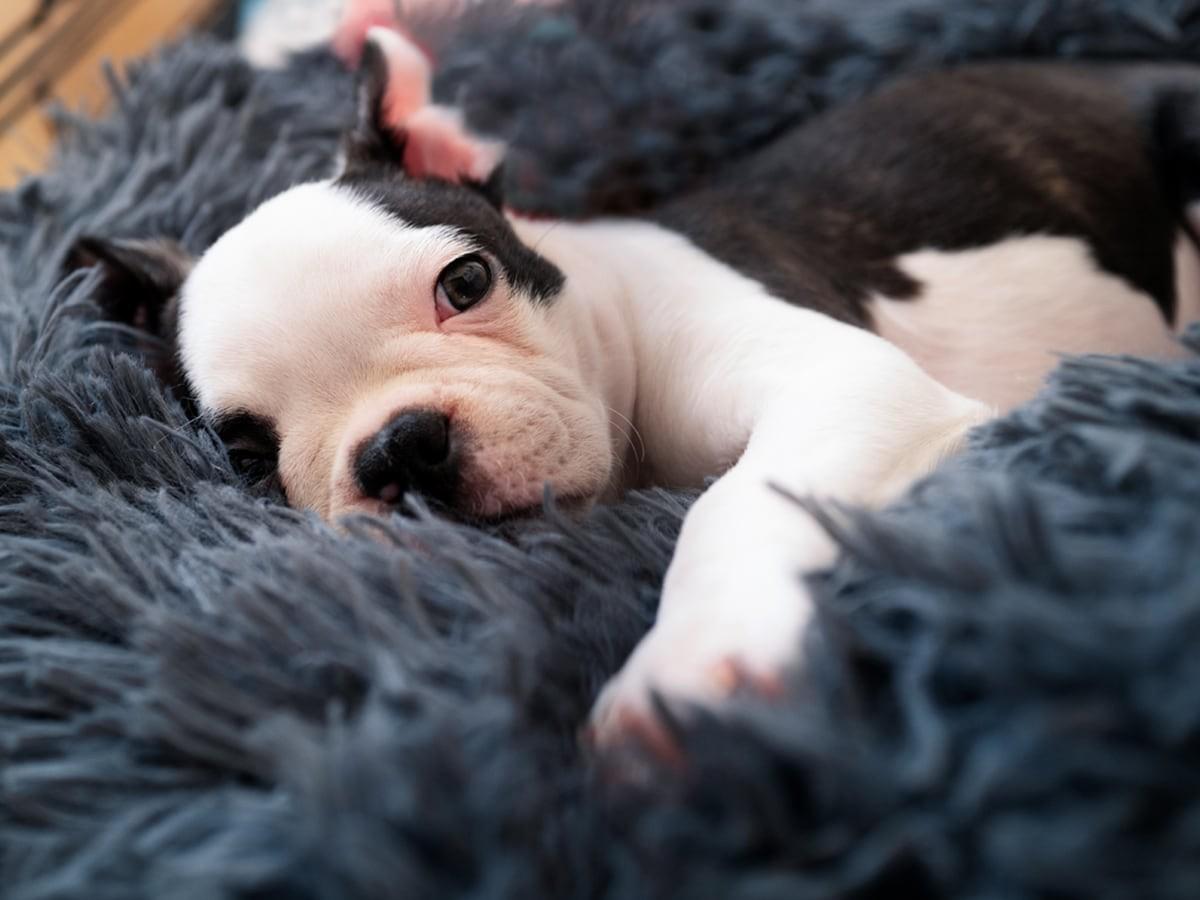
Puppies sleep 18–20 hours a day. According to the American Kennel Club¹, that high sleep demand exists because sleep supports the development of the central nervous system, brain, immune system, and muscles — all of which are growing rapidly in early puppyhood. As puppies age, their sleep needs drop gradually, settling near adult dog patterns (12–14 hours daily) by around 6 months.
How Much Sleep Do Puppies Need?
Most puppies need 15–20 hours of daily sleep, with the exact amount depending on age. Newborns spend almost all of their time sleeping, waking only to nurse. As puppies grow and waking hours stretch out, they shift from nearly constant sleep toward a pattern of shorter naps distributed throughout the day.
The American Kennel Club¹ reports that some young puppies sleep as much as 18–20 hours per day, with sleep being essential to healthy development at every stage. Adult dogs, by contrast, typically sleep 10–14 hours — still more than humans, but far less than the sleep young puppies require.
Age | Hours of Sleep | Notes |
|---|---|---|
Newborn (0–8 weeks) | 21–22 | Sleep almost constantly; wakes only to nurse or eat |
8 weeks (2 months) | 18–20 | Frequent naps; short, intense bursts of play between rest |
3 months | 15–18 | More awake time for training and play; still many naps |
4 months | 14–16 | Sleep begins to consolidate; longer stretches at night |
6 months+ | 12–14 | Sleep patterns resemble those of adult dogs |
Source: American Kennel Club¹
Why Do Puppies Sleep So Much?
Puppies sleep as much as they do because their bodies and brains are working hard to grow. According to the American Kennel Club¹, sleep contributes to the development of the central nervous system, brain, immune system, and muscles — and also helps puppies recover during growth spurts. The sleeping hours aren’t downtime; they’re when a significant portion of early development actually happens.
This also means that interrupting sleep — keeping a puppy awake for extended activity — isn’t neutral. Overtired puppies often become cranky, reactive, or harder to train because adequate rest is a prerequisite for the consolidation of learning. A puppy that seems hyperactive at the end of the day may actually be overtired rather than under-exercised.
Understanding the developmental context helps make sense of why the early weeks are so behaviorally sensitive. Sleep is one component of the larger picture of puppy socialization and brain formation — for a look at how behavioral changes unfold alongside physical growth, see the puppy fear stage.
Helping Your Puppy Sleep Through the Night
Young puppies cannot hold their bladder overnight. A common guideline is one hour per month of age plus one, so a 2-month-old puppy can typically go about 3 hours before needing a potty break. This means several overnight trips to the yard in early weeks, gradually spacing out as bladder control develops.
Predictable routines accelerate the transition to longer overnight stretches. A consistent evening schedule — dinner at the same time, a final outdoor potty trip, then settling in a designated sleep space — gives the puppy’s system reliable cues that sleep time has arrived. Keep evenings calm: reduced activity, low stimulation, and a quiet environment help signal the transition from waking to rest.
Crate training supports overnight sleep for many puppies. A properly sized crate (enough to stand, turn around, and lie flat) creates a den-like environment that naturally encourages rest. Puppies placed in a crate that’s too large may use one corner as a bathroom, undermining house training progress.
Is My Puppy Sleeping Too Much?
Context determines whether extra sleep is a concern. A puppy that slept more than usual after an active day, a vet visit, or a new vaccination is responding normally — exertion and immune activation both increase sleep demand. Brief increases in rest following growth spurts are also expected.
The signs that warrant a veterinary call are different from normal tiredness:
Difficulty waking for meals or water
Sudden, unexplained increase in sleep with no clear cause
Lethargy that persists across multiple days
Reduced interest in play or interaction during waking hours
Changes in appetite or bathroom habits alongside increased sleep
According to VCA Animal Hospitals², flat-faced (brachycephalic) breeds — including Bulldogs, Pugs, and Boxers— may be at particular risk for sleep apnea, which can cause excessive daytime sleepiness and should be evaluated by a veterinarian.
Pet insurance can help manage veterinary consultation costs if you’re navigating frequent check-ins during your puppy’s first year. For a breakdown of timing and coverage considerations, see is pet insurance worth it for a puppy.
Frequently Asked Questions
How much does a 3-month-old puppy sleep?
At 3 months, most puppies sleep 15–18 hours per day. The schedule is still nap-heavy — expect multiple rest periods distributed throughout the day, with bursts of activity in between. Training sessions at this age should be short (5–10 minutes), not only because of attention span but because a puppy that’s been awake and active for more than an hour typically needs to rest. Work with the nap schedule rather than against it.
How much should an 8-week-old puppy sleep?
An 8-week-old puppy typically sleeps 18–20 hours per day. At this age, awake windows are short — usually 1–2 hours at a stretch — followed by longer rest periods. This is the age when most puppies join their new homes, which means stimulation levels are high. Providing a quiet, comfortable space to retreat to is important so the puppy can take the rest it needs.
When will my puppy sleep through the night?
Most puppies begin sleeping through the night — or close to it — somewhere between 12 and 16 weeks, as bladder capacity increases and the body’s sleep-wake cycle matures. Getting there faster usually involves consistent crate use, a set bedtime routine, and avoiding overstimulation before sleep. Some puppies need a late-night potty trip even at 4 months; this is normal. Patience and routine consistency matter more than any single training technique.
How do I know if my puppy is getting enough sleep?
A well-rested puppy is alert and engaged during waking hours, eats normally, and settles into sleep without excessive fussing. Signs of undersleep include persistent hyperactivity or crankiness that doesn’t resolve with rest, difficulty focusing during brief training sessions, and general over-reactivity to normal stimuli. If your puppy is consistently hard to settle, evaluate whether the sleep environment, schedule, or total daily sleep time needs adjustment — and consult your vet if the pattern persists. For first-year health planning, see best age to insure your pet.
Every pet’s needs are different, which is why flexibility matters when choosing coverage. Whether you have a playful puppy, a senior cat, or multiple pets at home, pet insurance can help you feel more prepared for the unexpected.
Spot Pet Insurance helps cover pets starting at 8 weeks old with no upper age limit and offers plans in all 50 states, helping make coverage more accessible for pet families. Enroll your pet today.

The resident animal enthusiast at Spot. I have a lifetime of pet parent experience. If it has fur, feathers, or scales, I’ve probably shared my home with it. I aim to be a reliable source, blending experience with a dedication to the well-being of pets.
Reisen, Jan. “How to Make Sure Your Puppy Gets Enough Sleep.” American Kennel Club, American Kennel Club, 9 Nov. 2023, www.akc.org/expert-advice/health/how-much-do-puppies-sleep/.
Schaible, Laci . “How Much Sleep Do Puppies Need? | Chewy.” Chewy, 30 Apr. 2025, www.chewy.com/education/dog/health-and-wellness/how-much-should-puppies-sleep.
The Kennel Club. “Why Does My Puppy Sleep so Much | the Kennel Club.” Www.thekennelclub.org.uk, www.thekennelclub.org.uk/health-and-dog-care/health/health-and-care/a-z-of-health-and-care-issues/why-does-my-puppy-sleep-so-much/.