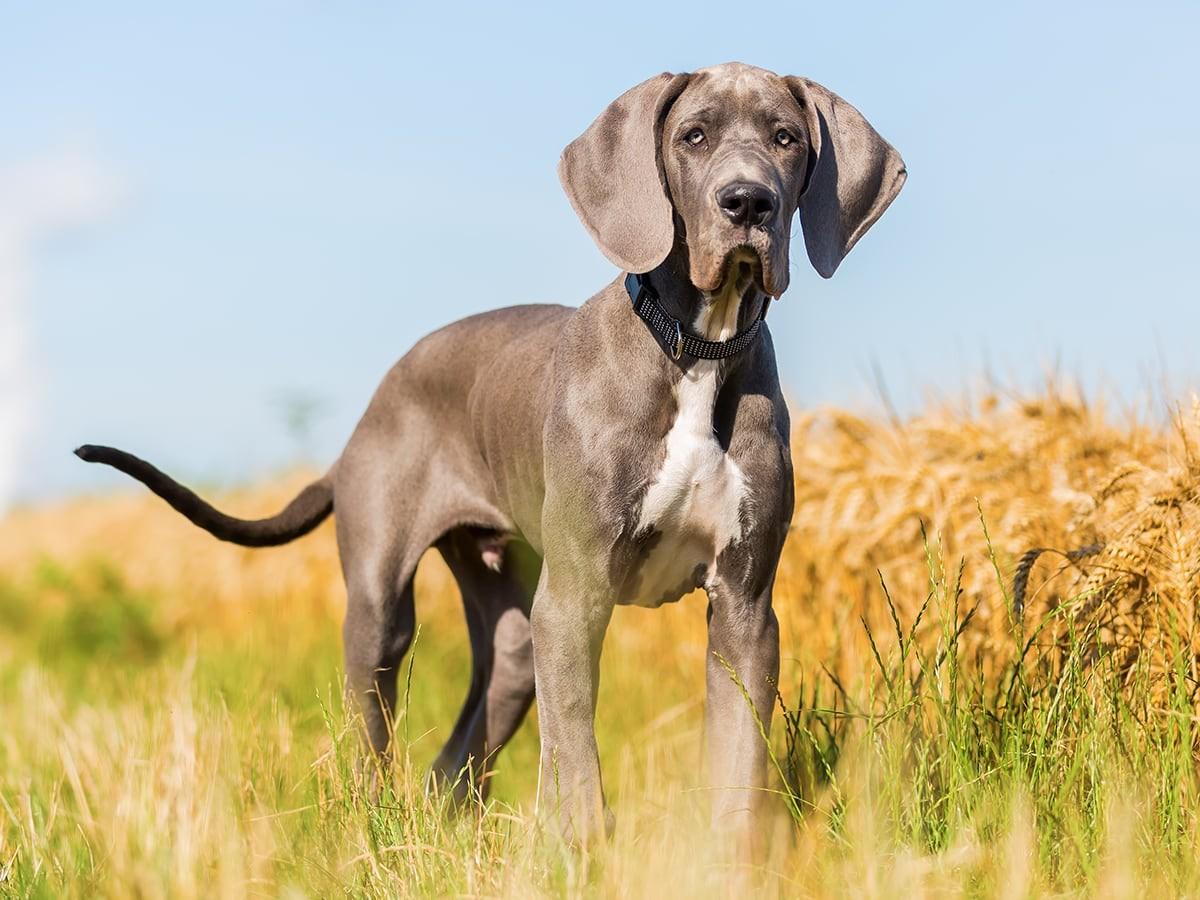
Great Dane pet insurance costs run well above the national average of $43 per month¹ for dog accident-and-illness coverage. The biggest driver is GDV (bloat): peer-reviewed research puts a Great Dane's lifetime risk of GDV at 36.7%², the highest of any breed studied. Add an elevated osteosarcoma risk and one of the shortest average lifespans of any large breed, and it's clear why insurers price this breed's coverage the way they do.
What Drives Great Dane Pet Insurance Costs?
Every dog's premium reflects general and breed-specific risk. Breeds with extensively documented hereditary conditions, like the Great Dane, typically see that risk reflected in pricing more than less-studied breeds.
Factor | Why It Matters for Great Danes |
|---|---|
Body size | As a giant breed, Great Danes generally need bigger medication doses and more extensive surgical cases, raising treatment costs |
Body type | A deep, narrow chest is directly linked to the breed's record-high GDV risk |
Genetic risk profile | Documented osteosarcoma and cardiac risk can lead to costly oncology or cardiology care |
Age at enrollment | Younger dogs typically start with lower premiums than dogs enrolled later in life |
Location | Regional veterinary costs vary, and insurers factor local pricing into your premium |
Breed is one of the most significant factors in premium pricing, alongside age, location, and plan design. See how much does pet insurance cost for a full breakdown of how these factors combine.
Health Risks That Drive Great Dane Insurance Pricing
Not every Great Dane develops these conditions, but their prevalence explains why insurers treat the breed as higher-risk than most.
GDV (Bloat): The Defining Risk for Great Danes
GDV happens when a dog's stomach fills with gas and twists on itself, cutting off blood flow to nearby organs — a life-threatening emergency that requires immediate surgery. Great Danes are the reference breed for this condition in veterinary epidemiology. A study published in Preventive Veterinary Medicine² found that Great Danes face a lifetime GDV risk of 36.7% (95% CI 25.2-44.6%)² — compared with just 3.9% for Rottweilers, one of the other breeds studied.² No other widely studied breed carries a higher documented lifetime GDV risk, which is why this single condition shapes so much of Great Dane coverage pricing.
Osteosarcoma: A Giant-Breed Cancer Risk
Osteosarcoma is an aggressive bone cancer that most often strikes the long bones of the legs, typically requiring amputation, chemotherapy, or both. It's strongly linked to body size, and giant breeds carry the highest documented risk of any size category. A 2023 VetCompass study³ found that Great Danes are 34.24 times more likely³ to develop osteosarcoma than crossbred dogs, with an annual prevalence of 0.87%³ in the breed.³ That's a distinct risk from the cardiac and orthopedic conditions that dominate pricing in other giant breeds, making oncology care a meaningful cost category here.
Heart, Joint, and Spinal Risks
Great Danes also carry a documented risk of dilated cardiomyopathy (DCM), a disease that weakens the heart muscle itself, unlike a valve-related murmur. Hip dysplasia, a hereditary joint disorder common in giant breeds, is well documented here and can progress into arthritis needing long-term management or surgery. Great Danes are also one of the two classic breeds linked to cervical vertebral instability, or "Wobbler syndrome" — a spinal cord condition that can cause an unsteady gait and, in advanced cases, may need surgery.
A Notably Short Lifespan Tied to These Risks
Great Danes are well-documented as having one of the shortest average lifespans of any large breed, commonly cited at 7 to 10 years⁴, according to VCA Animal Hospitals⁴. That shortened lifespan tracks with the breed's combined GDV, osteosarcoma, and cardiac risk — conditions that together account for much of the breed's serious health claims, which is another reason plan design and enrollment timing carry extra weight here.
What Do These Conditions Cost to Treat?
Costs vary by severity and location, but they show why these risks factor into pricing.
Condition | Cost Pattern |
|---|---|
GDV (bloat) emergency surgery | Time-sensitive; cost varies by severity, hospitalization length, and how quickly treatment begins |
Osteosarcoma diagnostics and treatment | Often imaging, biopsy, amputation or limb-sparing surgery, plus chemotherapy |
DCM monitoring and management | Ongoing cardiology screening and medication once diagnosed |
Hip dysplasia or Wobbler syndrome | Ranges from conservative care to surgery, depending on severity |
Choosing the Right Pet Insurance Plan for a Great Dane
Given a Great Dane's GDV and cancer risk, plan setup affects both your premium and your claim payout.
Deductible: A lower deductible reduces your out-of-pocket cost before reimbursement starts, but usually raises your premium; a higher deductible does the opposite.
Reimbursement rate: Most accident and illness plans let you choose a reimbursement rate, commonly 70% to 90% of the eligible bill. You pay the vet bill first, then submit a claim — the insurer doesn't pay the clinic directly. The formula: (vet bill − deductible) × reimbursement rate = reimbursement amount.
Annual limit: Because a single GDV emergency or a course of cancer treatment can generate a large bill for a dog this size, a higher or unlimited annual limit offers more protection in a high-claim year.
Enrollment timing: Because GDV can strike suddenly at any adult age and osteosarcoma tends to appear in midlife, enrolling your Great Dane young and symptom-free gives you the broadest coverage window. Conditions diagnosed beforehand, or during a waiting period, are generally treated as pre-existing and excluded from coverage.
Frequently Asked Questions
How much does pet insurance cost for a Great Dane?
There's no single published rate specific to Great Danes, but as a giant breed with documented GDV and osteosarcoma risk, premiums generally run well above the $43¹ national average for dog accident-and-illness coverage. Your actual cost depends on your dog's age at enrollment, your location, and the plan you choose.
Why is GDV such a big deal for Great Danes specifically?
Great Danes have the highest documented lifetime GDV risk of any breed studied — 36.7%², more than nine times the 3.9% rate found in Rottweilers in the same research. Because GDV is a sudden, life-threatening emergency requiring immediate surgery, insurers weigh this risk heavily when pricing coverage for the breed.
Does pet insurance cover osteosarcoma treatment in Great Danes?
Accident and illness plans can generally help cover diagnostics, surgery, and chemotherapy for osteosarcoma once it's diagnosed after your coverage begins and any waiting period passes — but not if symptoms appeared first. Reviewing a sample policy for how it handles cancer diagnostics and ongoing treatment is worth doing before you enroll.
When should I enroll my Great Dane in pet insurance?
Enrolling as a puppy, before GDV, osteosarcoma, or other breed-linked conditions appear, gives you the broadest coverage window and typically the lowest starting premiums. Because this breed's biggest risks can develop suddenly or in midlife, waiting longer increases the chance a condition gets excluded as pre-existing.
Protecting Your Great Dane's Coverage
Unexpected vet bills can happen when you least expect them, but pet insurance may help make those costs more manageable. Having coverage in place can help pet parents feel more prepared for emergency care, surgery, diagnostics, and treatment for covered conditions.
Spot Pet Insurance offers dog insurance plans starting at $15/month^ and cat insurance plans starting at $9/month^^, helping to make it easier to find coverage that fits your budget. Spot also makes filing claims simple with a digital claims process that lets pet parents submit a claim in 60 seconds or less. Get a free quote.
^ Advertised premium is based on an accident and illness plan with an 80% reimbursement rate, $500 annual deductible, and a $2,500 annual limit for a 2-year-old small mixed dog (11-25lbs) in 32009. Plan costs vary.
^^ Advertised premium is based on an accident and illness plan with an 80% reimbursement rate, $750 annual deductible, and a $2,500 annual limit for a 2-year-old mixed cat in 33801. Plan costs vary.

We’re pet parents first—and writers, marketers, and product developers by trade—combining lived experience with industry expertise in everything we create.
Insurify. "How Much Does Pet Insurance Cost?" Insurify, updated May 2026. https://insurify.com/pet-insurance/average-pet-insurance-cost/
Ward, M.P., Patronek, G.J., Glickman, L.T. "Benefits of Prophylactic Gastropexy for Dogs at Risk of Gastric Dilatation-Volvulus." Preventive Veterinary Medicine, 2003. https://pubmed.ncbi.nlm.nih.gov/12941556/
O'Neill, D.G., et al. "Dog Breeds and Conformations Predisposed to Osteosarcoma in the UK: A VetCompass Study." Canine Medicine and Genetics, 2023;10:8. https://pmc.ncbi.nlm.nih.gov/articles/PMC10294386/
VCA Animal Hospitals. "Great Dane." VCA Animal Hospitals. https://vcahospitals.com/know-your-pet/dog-breeds/great-dane